Einstein's Brain.

There was a recent issue of National Geographic about genius. What is it? What creates the environment for it? (May 2017) "Genius" by Claudia Kalb, "Some minds are so exceptional that they change the world. We don't know what exactly makes these extraordinary people soar above the rest of us, but science offers us clues."
The article talks about the creation of the IQ test, and how it was conceived as a way of understanding genius. People who had high IQs were followed for years, and it turned out - they had the same outcomes as most people. Out of their control group, 2 had gone on to some fame in their field, but the rest struggled like... well, the rest of us. So high IQ doesn't mean that a person will achieve great success, but it arguably "sets the table" for someone to achieve that label.
The article talked about Michelangelo's genius, and compared how some famous geniuses had a "circle of genius friends" who were also very talented, and they had charts and maps of how by charting "social networks" of genius, there might be clues as to how and why they accomplished so much.
They repeated the myth that Michelangelo took a "discarded piece of marble" and crafted the David from it. Actually, as I learned while researching "the Demedicis" for HBO, Mick won the marble in a contest. His father had notified him in Rome this monster piece was being offered in a contest, and convinced the 25 year old to enter. Mick found a flaw in the marble, which would have made it worthless - but he followed the fault with his chisel to start the knee of this statue.
For those familiar with his technique, he "let the person emerge" from the marble - honing small details first, knowing precisely how they would work in the overall piece. In other words he "saw the statue inside the marble" before he began.
Most sculptors work "outside in" - shaping as they go along, chipping away what wasn't necessary, but in Mick's case, he did the opposite. Revealed the statue within.
They also miss out on the point that Lorenzo De Medici, 20 at the time, met Michelangelo when he was 11 and a student of the Academy. Lorenzo saw his genius, brought him into his home, and allowed him to flourish amid their "Platonic Academy" where they would read Plato (many for the first time) in Italian (Lorenzo's father Piero had them transcribed from Latin to the local language so anyone could read Plato and Socrates) - and not just those books okay'd by the Vatican. This is why the Pope sent an assassin to kill Lorenzo and his brother Giuliano (the model in Botticelli's "Primavera") but that's another story...)
The article points to this ability in geniuses.
Seeing things from a different perspective. Being able to "see a building" in 3 dimensions - or as Nick Tesla revealed that he "saw his inventions as fully functioning objects in his mind" before he went to a prototype.
Beethoven credited his genius not with the other artists he knew, or his circle of friends, or his "social network." He firmly credited it with coming from "the outer spheres" - E. T. A. Hoffmann, the author and music critic: "Beethoven is the "sublimest" of composers: his music "opens the realm of the colossal and immeasurable," and "leads the listener away into the wonderful spiritual realm of the infinite."
Beethoven said as much about his inspiration. It came from the outer realms - he was not a religious man in the Age of Reason, but claimed that the source of his inspiration came from "beyond our realm."
He was accessing the Flipside in order to download his music.
But the point of this Martini Shot essay is to open up a new avenue to understanding "genius."
If what thousands have said in this research is accurate: that we use consciousness the way a computer uses hard drives, that a portion of our consciousness is "always back home" while we are here - if it's true that we "only bring about a third of our conscious energy to a lifetime" and that "roughly two thirds is always "back home" while we are on the planet" - then we have to redefine what genius actually is.
Because science is married to the concept that consciousness is dependent upon genetics and sociological factors, and the brain is like a computer that is filled with information, and then "for some inexplicable reason" uses that information to make us believe we are conscious. (In a Martini nutshell)

That's an unfortunate way to view life on earth - but it's pretty much what science thinks is the case.
That "the brain is the sole creator of thought." That If we slice up the brain we'll find out how the brain works.
There's a photograph in the article of the slices of Einstein's brain that they carved up, put on slides, and is on display at the National Museum of Health and Medicine in Maryland.
So what the heck are slices of Einstein's brain doing in a museum?
It's like taking apart a stereo receiver to figure out why Beethoven's Ninth is playing inside of it. Or taking apart a speaker to examine why music is coming from inside. Or looking for the tiny man in the operator suit who is hiding inside the machine.
Post materialist scientists (like Dr. Greyson at UVA) claim the brain functions like a stereo or television receiver. That is uses limiters and filters to parse information into where it is needed or can be used.
They claim the brain functions like a receiver of consciousness, that it is not the only source of consciousness, since people have yet to wrap their brain around this research - And until we do, we will forever be slicing up brains thinking that's the source of consciousness. Or that's the only place to find it.
As the research shows, the brain is not the only source of consciousness. By "research" I'm citing clinical psychologist Dr. Helen Wambach's 2000 cases of people under hypnosis claiming that we "plan our lifetime" that we are consciously aware of what or who we are going to be prior to coming to the planet, or a decade later psychologist Michael Newton's 7000 cases (a decade later) where people consistently claim that we come to the planet "around the 4th month of inception" and that we exist prior to coming here, that the majority of our conscious energy ("soul") remains behind or "back home" while we are here, and is accessible in "outside consciousness events" (NDEs, OBEs, LBLs, etc)....

Or by citing Dr. Bruce Greyson's youtube talk "Is Consciousness Produced by the Brain?" which I reproduce in "It's a Wonderful Afterlife." He argues with medical cases that consciousness is "not only produced by the brain." (Go ahead, click the link, it's only 90 minutes; I'll wait.)
I'm also including the 45 hypnosis sessions I've filmed (4-6 hours each) and the 5 that I've done myself.
"Consciousness is NOT confined to the brain."
It's funny. This sentence upsets some people. They argue "the reason people "believe in the afterlife" is because they "fear death, they fear annihilation." I would argue the opposite. The "belief" that life ends is the issue. That the word "believe" is the culprit. If you've experienced something (NDE, OBE, LBL) "belief" becomes "experience." Either one experiences it or does not.
In terms of NDEs, thousands claim they "know" that life goes on, in LBL (between life hypnosis) sessions, people "experience" "returning home" after this lifetime. ("Home" is their word).
The point is; eyewitness reports should not engender fear or disbelief, but rather a desire to understand where they come from and if evidence shows they could not have made it up or learned it elsewhere to examine the consistency in those reports.
If we can prove there is "new information" during the event, (as I do in my books) then it can't be coming from the brain. New information can't be cryptomnesia, synesthesia or hypoxia. If the information turns out to be accurate, then the experience therefore cannot be created by the brain.
The brain functions like a stereo receiver, with limiters, filters and ways of parsing that information where it should go.
We can access our "higher consciousness" through hypnosis, meditation, out of body experiences, near death events. When we do so we get a glimpse of the amount of information that we have access to.
People claim that we have "portable hard drives" that follow us around in the shape of geometric fractals that "contain all the information from our previous lifetimes." ("Flipside")
It's not my theory that occurs, or my belief that's the case, but is what people consistently report. Not all the time - but enough times that I can argue what these geometric shapes supposedly contain.
"Access codes."
The Beethoven's Ninth is hiding an Access Code. Listen to it in its entirety and you'll see what I mean. (I'm kidding but kind of not kidding.)
Not literally, figuratively.
Access to our "higher consciousness" which does not float around the universe like a Carl Jungian pool of consciousness - it would be cool if that was the case, but that's in none of the reports. What is in the reports is the consistent claim that we are unique - we have our own consciousness that is ours, but by the nature of how consciousness works - we can shift our perspective, experience other people's experiences, or tap into the vast feelings of love that connect us all.
So genius - isn't confined to the brain.
It does have a "social network" in the sense that we seek out, in a quantum entanglement fashion, the people and loved ones that we normally incarnate with. That we've already made a plan with to reconnect with again in this lifetime. That we find ourselves running into and feeling "as if we've known them forever."
Because, in a sense, we have. We've known them "before" and continue work and hang out with them again.
When we come here we choose a lifetime that we think we can handle. When we are here, there are environmental aspects that are conducive to helping us achieve our goals. (In the article they cite how rappers and other musicians are able to "supress pathways" or "open pathways" that allow them to access spatial information we aren't normally aware of.)
So - it is possible for a person to "open up those pathways" to access more information?

Meditation allows the brain to "work out" like an athlete would to get certain muscles to function better. Meditation can open the mind up to other possibilities.
Reading about others journey or path can open our mind up to these possibilities. I know when I first began reading Michael Newton's work, I avoided his conclusions about what happening and focused just on the first hand reports. Later, after I confirmed beyond my ability to deny what they were saying was accurate, I went back and read his comments about what people were telling him.
Finding a Newton Institute trained therapist and doing a between life session will grant access to that "higher information." (I recommend them because they are familiar with the architecture of the flipside, and know what questions to ask. They have a searchable database on their site.)
Indeed, doing a between life session led me to the other research, to interviewing people who've had near death events, or people who've had contact with loved ones either through dreams or a medium or some other fashion - to see if the portrait or the architecture of the "afterlife" was the same.
Indeed, to my chagrin, it was.
The architecture of the afterlife is a knowable entity. Reportedly we don't bring "all of our consciousness" to a lifetime because it would "blow the circuits of the brain" with "too much energy." (And we do see people walking around the planet with blown circuits as it is.)
But we can access this information in such a way as to not harm our path and journey, and in such a way that we can gain insight into why and how we came to the planet, and what happens to us when we depart it. (In a spiritual sense.)
But in the future, we won't be slicing up people's brains to understand why they worked. It's like taking apart a tennis shoe to understand why a runner is so fast. Or taking apart a car to understand how it can win so many races. Certainly the construction of the tool is important, and the ability to use it with ease is important. But equally important is the pilot, the person running the race or driving the car, who brings their skill and ability to that particular task, and further, they're bringing the ability to access "all their other lifetimes" or to think in a spatial way that is "open to the answer no matter where it comes from."
Hence why Einstein used to play his violin in order to think.
It wasn't because it was a casual thing to do. It's because he was using music as a way of linking up with the flipside and downloading the answers.

You're welcome.


There was a recent issue of National Geographic about genius. What is it? What creates the environment for it? (May 2017) "Genius" by Claudia Kalb, "Some minds are so exceptional that they change the world. We don't know what exactly makes these extraordinary people soar above the rest of us, but science offers us clues."
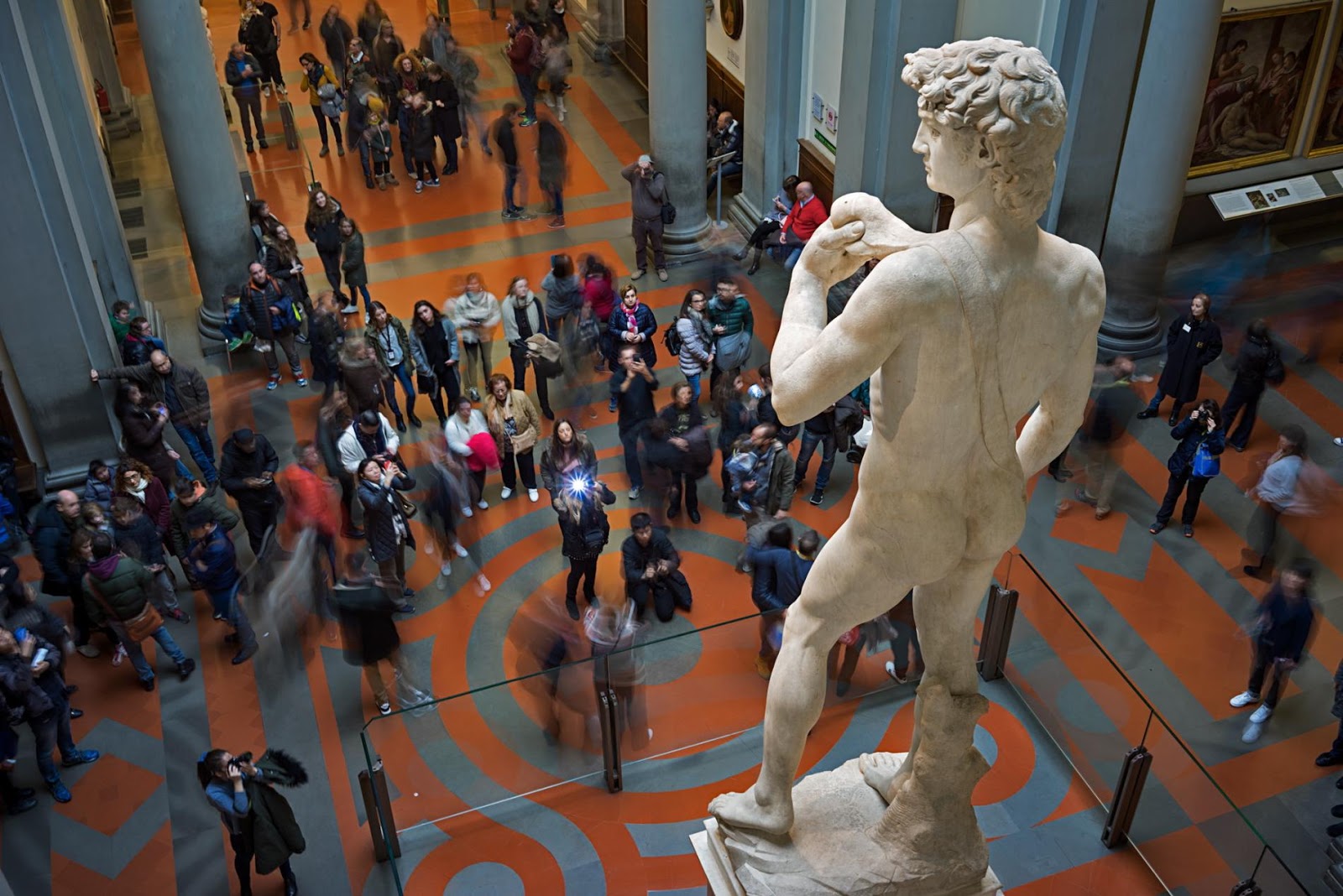 |
| Michelangelo's David. Photo by Paolo Woods (NG) May 17 |
The article talks about the creation of the IQ test, and how it was conceived as a way of understanding genius. People who had high IQs were followed for years, and it turned out - they had the same outcomes as most people. Out of their control group, 2 had gone on to some fame in their field, but the rest struggled like... well, the rest of us. So high IQ doesn't mean that a person will achieve great success, but it arguably "sets the table" for someone to achieve that label.
The article talked about Michelangelo's genius, and compared how some famous geniuses had a "circle of genius friends" who were also very talented, and they had charts and maps of how by charting "social networks" of genius, there might be clues as to how and why they accomplished so much.
They repeated the myth that Michelangelo took a "discarded piece of marble" and crafted the David from it. Actually, as I learned while researching "the Demedicis" for HBO, Mick won the marble in a contest. His father had notified him in Rome this monster piece was being offered in a contest, and convinced the 25 year old to enter. Mick found a flaw in the marble, which would have made it worthless - but he followed the fault with his chisel to start the knee of this statue.
For those familiar with his technique, he "let the person emerge" from the marble - honing small details first, knowing precisely how they would work in the overall piece. In other words he "saw the statue inside the marble" before he began.
Most sculptors work "outside in" - shaping as they go along, chipping away what wasn't necessary, but in Mick's case, he did the opposite. Revealed the statue within.
They also miss out on the point that Lorenzo De Medici, 20 at the time, met Michelangelo when he was 11 and a student of the Academy. Lorenzo saw his genius, brought him into his home, and allowed him to flourish amid their "Platonic Academy" where they would read Plato (many for the first time) in Italian (Lorenzo's father Piero had them transcribed from Latin to the local language so anyone could read Plato and Socrates) - and not just those books okay'd by the Vatican. This is why the Pope sent an assassin to kill Lorenzo and his brother Giuliano (the model in Botticelli's "Primavera") but that's another story...)
 |
| Mick's patron, a poet turned ruler Lorenzo |
The article points to this ability in geniuses.
Seeing things from a different perspective. Being able to "see a building" in 3 dimensions - or as Nick Tesla revealed that he "saw his inventions as fully functioning objects in his mind" before he went to a prototype.
Beethoven credited his genius not with the other artists he knew, or his circle of friends, or his "social network." He firmly credited it with coming from "the outer spheres" - E. T. A. Hoffmann, the author and music critic: "Beethoven is the "sublimest" of composers: his music "opens the realm of the colossal and immeasurable," and "leads the listener away into the wonderful spiritual realm of the infinite."
Beethoven said as much about his inspiration. It came from the outer realms - he was not a religious man in the Age of Reason, but claimed that the source of his inspiration came from "beyond our realm."
He was accessing the Flipside in order to download his music.
But the point of this Martini Shot essay is to open up a new avenue to understanding "genius."
If what thousands have said in this research is accurate: that we use consciousness the way a computer uses hard drives, that a portion of our consciousness is "always back home" while we are here - if it's true that we "only bring about a third of our conscious energy to a lifetime" and that "roughly two thirds is always "back home" while we are on the planet" - then we have to redefine what genius actually is.
Because science is married to the concept that consciousness is dependent upon genetics and sociological factors, and the brain is like a computer that is filled with information, and then "for some inexplicable reason" uses that information to make us believe we are conscious. (In a Martini nutshell)

That's an unfortunate way to view life on earth - but it's pretty much what science thinks is the case.
That "the brain is the sole creator of thought." That If we slice up the brain we'll find out how the brain works.
There's a photograph in the article of the slices of Einstein's brain that they carved up, put on slides, and is on display at the National Museum of Health and Medicine in Maryland.
 |
| Slices of Einstein's Brain |
It's like taking apart a stereo receiver to figure out why Beethoven's Ninth is playing inside of it. Or taking apart a speaker to examine why music is coming from inside. Or looking for the tiny man in the operator suit who is hiding inside the machine.
 |
| Oh look. A slice of Einstein's actual brain. |
Post materialist scientists (like Dr. Greyson at UVA) claim the brain functions like a stereo or television receiver. That is uses limiters and filters to parse information into where it is needed or can be used.
They claim the brain functions like a receiver of consciousness, that it is not the only source of consciousness, since people have yet to wrap their brain around this research - And until we do, we will forever be slicing up brains thinking that's the source of consciousness. Or that's the only place to find it.
As the research shows, the brain is not the only source of consciousness. By "research" I'm citing clinical psychologist Dr. Helen Wambach's 2000 cases of people under hypnosis claiming that we "plan our lifetime" that we are consciously aware of what or who we are going to be prior to coming to the planet, or a decade later psychologist Michael Newton's 7000 cases (a decade later) where people consistently claim that we come to the planet "around the 4th month of inception" and that we exist prior to coming here, that the majority of our conscious energy ("soul") remains behind or "back home" while we are here, and is accessible in "outside consciousness events" (NDEs, OBEs, LBLs, etc)....

Or by citing Dr. Bruce Greyson's youtube talk "Is Consciousness Produced by the Brain?" which I reproduce in "It's a Wonderful Afterlife." He argues with medical cases that consciousness is "not only produced by the brain." (Go ahead, click the link, it's only 90 minutes; I'll wait.)
I'm also including the 45 hypnosis sessions I've filmed (4-6 hours each) and the 5 that I've done myself.
"Consciousness is NOT confined to the brain."
It's funny. This sentence upsets some people. They argue "the reason people "believe in the afterlife" is because they "fear death, they fear annihilation." I would argue the opposite. The "belief" that life ends is the issue. That the word "believe" is the culprit. If you've experienced something (NDE, OBE, LBL) "belief" becomes "experience." Either one experiences it or does not.
In terms of NDEs, thousands claim they "know" that life goes on, in LBL (between life hypnosis) sessions, people "experience" "returning home" after this lifetime. ("Home" is their word).
 |
| By "home" they don't mean here. |
The point is; eyewitness reports should not engender fear or disbelief, but rather a desire to understand where they come from and if evidence shows they could not have made it up or learned it elsewhere to examine the consistency in those reports.
If we can prove there is "new information" during the event, (as I do in my books) then it can't be coming from the brain. New information can't be cryptomnesia, synesthesia or hypoxia. If the information turns out to be accurate, then the experience therefore cannot be created by the brain.
The brain functions like a stereo receiver, with limiters, filters and ways of parsing that information where it should go.
 |
| Oh look, here's how I parse information I get from the Flipside. |
We can access our "higher consciousness" through hypnosis, meditation, out of body experiences, near death events. When we do so we get a glimpse of the amount of information that we have access to.
People claim that we have "portable hard drives" that follow us around in the shape of geometric fractals that "contain all the information from our previous lifetimes." ("Flipside")
It's not my theory that occurs, or my belief that's the case, but is what people consistently report. Not all the time - but enough times that I can argue what these geometric shapes supposedly contain.
"Access codes."
The Beethoven's Ninth is hiding an Access Code. Listen to it in its entirety and you'll see what I mean. (I'm kidding but kind of not kidding.)
Not literally, figuratively.
Access to our "higher consciousness" which does not float around the universe like a Carl Jungian pool of consciousness - it would be cool if that was the case, but that's in none of the reports. What is in the reports is the consistent claim that we are unique - we have our own consciousness that is ours, but by the nature of how consciousness works - we can shift our perspective, experience other people's experiences, or tap into the vast feelings of love that connect us all.
So genius - isn't confined to the brain.
It does have a "social network" in the sense that we seek out, in a quantum entanglement fashion, the people and loved ones that we normally incarnate with. That we've already made a plan with to reconnect with again in this lifetime. That we find ourselves running into and feeling "as if we've known them forever."
Because, in a sense, we have. We've known them "before" and continue work and hang out with them again.
 |
| Another fellow who seemed to have access to multiple lives |
So - it is possible for a person to "open up those pathways" to access more information?

Meditation allows the brain to "work out" like an athlete would to get certain muscles to function better. Meditation can open the mind up to other possibilities.
Reading about others journey or path can open our mind up to these possibilities. I know when I first began reading Michael Newton's work, I avoided his conclusions about what happening and focused just on the first hand reports. Later, after I confirmed beyond my ability to deny what they were saying was accurate, I went back and read his comments about what people were telling him.
 |
| Hmm. Space. The first frontier. |
Finding a Newton Institute trained therapist and doing a between life session will grant access to that "higher information." (I recommend them because they are familiar with the architecture of the flipside, and know what questions to ask. They have a searchable database on their site.)
Indeed, doing a between life session led me to the other research, to interviewing people who've had near death events, or people who've had contact with loved ones either through dreams or a medium or some other fashion - to see if the portrait or the architecture of the "afterlife" was the same.
Indeed, to my chagrin, it was.
 |
| Flipside. It's a Wonderful Afterlife. Hacking the Afterlife. |
The architecture of the afterlife is a knowable entity. Reportedly we don't bring "all of our consciousness" to a lifetime because it would "blow the circuits of the brain" with "too much energy." (And we do see people walking around the planet with blown circuits as it is.)
But we can access this information in such a way as to not harm our path and journey, and in such a way that we can gain insight into why and how we came to the planet, and what happens to us when we depart it. (In a spiritual sense.)
But in the future, we won't be slicing up people's brains to understand why they worked. It's like taking apart a tennis shoe to understand why a runner is so fast. Or taking apart a car to understand how it can win so many races. Certainly the construction of the tool is important, and the ability to use it with ease is important. But equally important is the pilot, the person running the race or driving the car, who brings their skill and ability to that particular task, and further, they're bringing the ability to access "all their other lifetimes" or to think in a spatial way that is "open to the answer no matter where it comes from."
 |
| E equals what again? |
Hence why Einstein used to play his violin in order to think.
It wasn't because it was a casual thing to do. It's because he was using music as a way of linking up with the flipside and downloading the answers.

You're welcome.